Beauty & skin care
LED Mask Irradiance and Dose: A Practical Guide
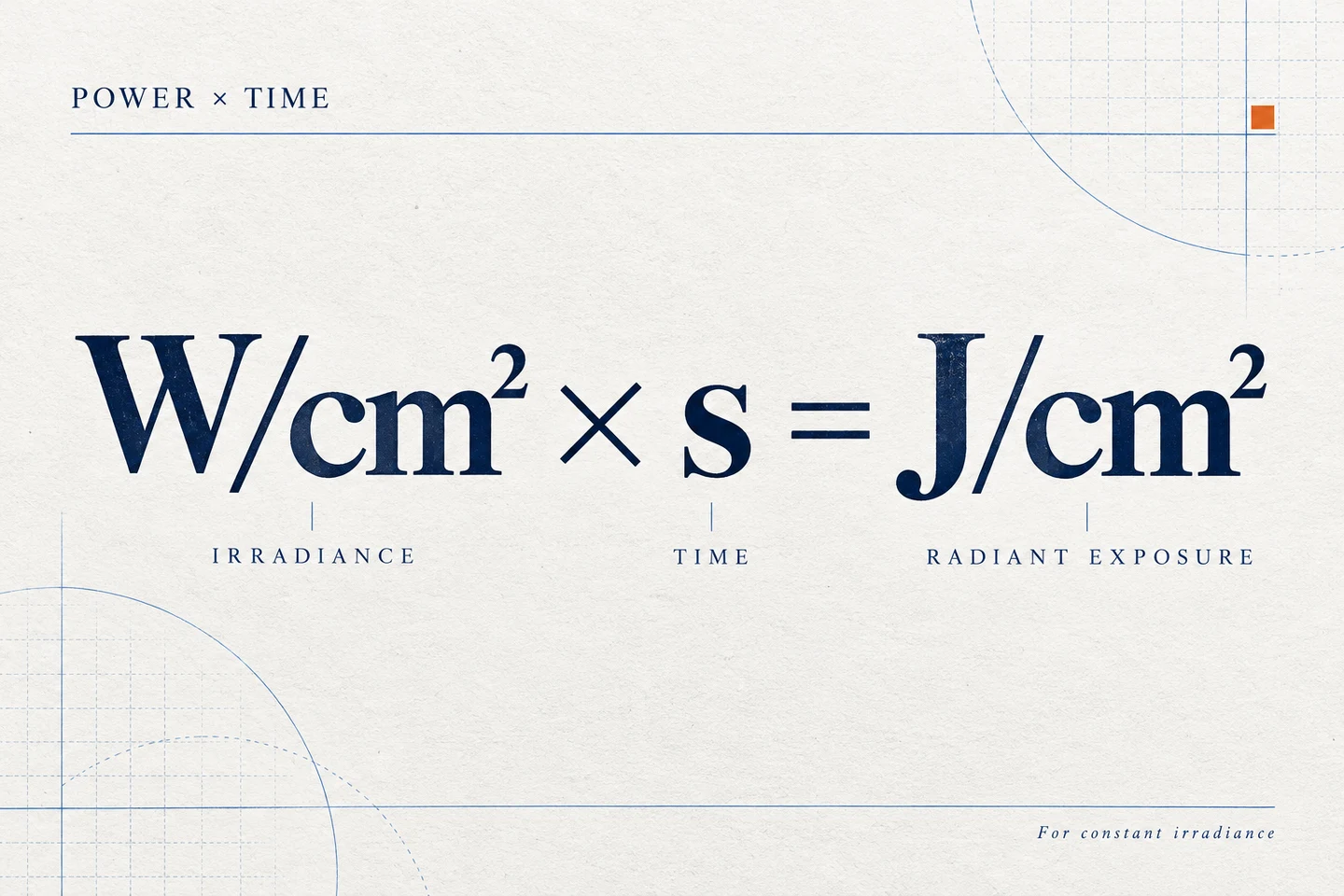
Irradiance describes optical power arriving at an area. Dose, often expressed as radiant exposure or fluence, includes exposure time. Understanding the distinction helps you read an LED mask specification without treating the biggest number as the best result.
Understand the units
Irradiance is commonly reported in milliwatts per square centimeter, or mW/cm². Radiant exposure is commonly reported in joules per square centimeter, or J/cm².
For constant irradiance at a measurement plane, the calculation is:
Radiant exposure = irradiance in W/cm² × time in seconds.
For example, a hypothetical constant 30 mW/cm² measured for 600 seconds corresponds to 18 J/cm² at that plane. This is a calculation example, not a recommended dose or a claim about any product.
Ask how the output was measured
A useful report states the measurement distance, operating mode, instrument, and whether the value is a peak or an average across the treatment area. For pulsed output, ask how the duty cycle was handled. For multiple wavelengths, ask whether the figure combines channels.
A reading at one point does not establish uniform exposure across an entire face. The distance and angle between emitters and skin can vary when a mask is worn. A measurement map is therefore more informative than an unexplained single value.
Do not change the schedule using arithmetic alone
The dose calculation describes physical exposure; it does not establish a safe or effective routine. Photobiomodulation research describes dose-dependent responses, so increasing exposure cannot simply be assumed to improve results. See the research discussion.
Use the manufacturer's validated instructions rather than extending or combining sessions to chase a numerical target.
Compare like with like
Before comparing two output figures, check that the measurement conditions match. A peak reading close to an emitter and an average reading at the intended treatment distance answer different questions.
If the report lacks units or conditions, request clarification. A smaller, well-explained figure can be more useful for evaluation than a larger number without a method.
FAQ
Is electrical wattage the same as irradiance? No. Electrical input power does not directly describe optical power per unit area at the treatment surface.
Can I double the time to improve results? Do not use a dose calculation to override the product's session instructions.
Next step: Ask for output data with units, operating mode, and measurement conditions.
Request model-specific output information
Review HIG MMZ01 and HIG MMZ02, or contact us to request the current manual and available optical output documentation for the exact model. The hypothetical values in this article are not measurements of these products.
Related reading: How to Choose a Red Light Therapy Mask.